

Orbital Mining
Orbital Miners let you work mineral deposits with ships. They can supplement a crowded colony or develop an extraction site before you settle it, provided the miners remain in orbit and their operation is supplied.
Buildings in this chapter
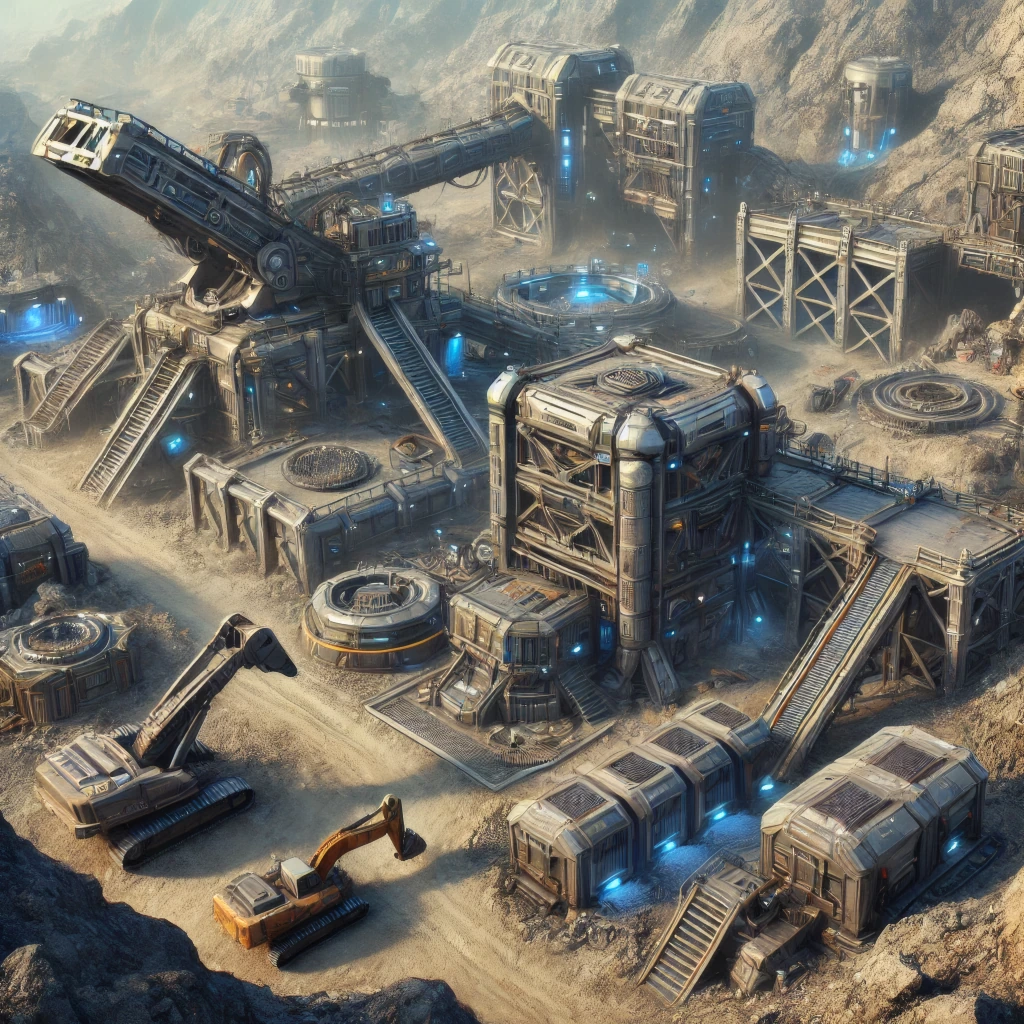

Choose ships or an orbital building
An Orbital Miner is a civilian ship that extracts common and rare minerals. Researching Asteroid Mining unlocks its blueprint, after which you construct it through ship production. The extracted minerals enter the shared imperial stockpile, just like material from a colony's mines. You do not need to fill a cargo hold and send it home after each delivery.
An Asteroid Mine is a different asset. It is a colony building unlocked by Asteroid Claim Engineering, and it needs local workers, power and supplies. It also produces strategic materials, which Orbital Miner ships do not. The distinction matters when deciding how to expand: a colony short of workers may benefit from mining ships, while an established mining world may be able to sustain the building and make use of its different mix of output.
Set up a working extraction site
At an owned colony, Orbital Miners can work while stationed with the system's ships. To mine an uncolonized system, form a fleet, move it into orbit and leave it idle there after arrival. It must have no active mission and no movement destination. Travelling past a deposit, exploring through it or continuing a patrol does not create an ongoing mining operation.
Mining fleets can use deposits in your own systems and uncolonized systems. They cannot extract from a system belonging to another empire. Choose the site from its common and rare abundance, then confirm the fleet is actually holding position at the system. The two minerals respond to their own deposits and research improvements, so an attractive common site is not automatically an attractive rare site.
Treat remote miners as a supplied fleet
Mining ships do not draw on a colony's building workforce or local power grid, but their crews and fuel still need funding. Stationed miners use their funded operating level; deployed miners depend on the fleet's supply readiness. A remote operation that cannot sustain its costs produces less, so compare the mineral return with the additional fleet burden before sending more hulls beyond your developed territory.
Remote miners also need protection. Their continued presence exposes valuable civilian ships at the extraction site, while relocation interrupts the extraction you were relying on. Station miners when you want a lower fuel burden at an owned colony, and use a deployed group when access to an unsettled deposit justifies it. Colony precision and bulk mining modes change mine buildings; they do not change the ship's extraction mode.
Recover useful material after battle
Orbital Miners also have a salvage role. Qualifying fleet battles can leave debris containing recoverable common minerals, rare minerals, strategic materials and fuel. Debris inside an empire's controlled territory is recovered for that empire; in unclaimed space, a nearby idle salvage-capable fleet or stationed salvage ship can secure it. Recovery takes time, and uncollected debris eventually expires.
This is a useful reason to keep civilian support near a secured battlefield, but it is separate from normal deposit extraction. A debris field does not make every nearby mining site permanently richer, and its finite contents cannot replace the recurring income of a working mining operation.
Advanced details
Open the calculations and current reference values when you want to plan more precisely. Production figures assume the stated conditions; your colony and technology bonuses can change the result.
Yield, orbit and operating level
An Orbital Miner has base mining yield 300. At 100 common and rare abundance, full operating supply and neutral technology, it produces 300 common and 20 rare minerals per tick. Common and rare output each use their own abundance, recovery and production modifiers. Orbital production does not use the colony's building worker ratio or local power supply.
An eligible deployed fleet has mission None, no destination coordinates and a position within 2,000 map units of an owned or uncolonized system. Its yield is scaled by supply readiness. Miners stationed at an owned system use their funded ship operating ratio. The ship's base wage rating is 2,000, giving 100 credits per tick before wage technology; its fuel rating is 15, before the stationed/deployed multipliers and fleet adjustments.
Common yield = 300 × miner count × operating supply × common abundance / 100 × common recovery modifier × common production modifierRare yield = (300 / 15) × miner count × operating supply × rare abundance / 100 × rare recovery modifier × rare production modifierBattlefield salvage limits
A qualifying debris field contains 10% of lost ships' base common, rare and strategic construction materials and 5% of their construction fuel, subject to rounding. Fields last 30 ticks if not collected. Collection takes 3–12 ticks depending on the battle's lost ship count, distributing the remaining contents over the remaining recovery ticks.
Outside controlled territory, idle salvage collectors must be within 2,000 map units. Territorial control has priority; otherwise the nearest eligible fleet or stationed collector determines the recovering empire. Debris is created when at least 10 ships were lost or its weighted mineral contents reach the qualifying threshold.