
Resource production and upkeep
Building descriptions show base output. Actual production depends on local deposits, workers, power, supplies, and research; the results feed the stockpile shared by your empire.
 CreditsInfrastructure, construction, wages
 CommonBulk construction material
 RareAdvanced components
 StrategicHigh-tier industry and warfare
 FuelFleets, facilities, expansion
From deposit to stockpile
- 01Start with completed buildings
Enabled buildings can produce resources each tick when their workers, power, and operating supplies are available.
- 02Apply the local system
Common, rare, and fuel extraction scale with that system's abundance percentages.
- 03Provide workers and research
Fill the jobs required by active buildings. A worker shortage reduces most buildings' output; research can improve production or reduce requirements.
- 04Apply disruption
Active resource-production sabotage reduces positive output without reducing upkeep.
- 05Check what remains
Combine all income, then account for building costs, fleet wages, projects, trade, and diplomatic payments. The Economy tab shows how your stockpiles change.
Plan from actual production
Compare what a colony produces with what it needs to keep running. Adding another factory helps only when there are enough workers, power, minerals, and fuel to operate it.
Small production bonuses accumulate over time, even when your stockpile displays whole units. Shortages reduce the affected activity and its spending instead of allowing a resource balance to fall below zero.
What changes production
Common, rare, and fuel percentages are local deposit quality. Prioritize the matching extraction building where the percentage is strongest.
Residents serving as troops are unavailable for civilian jobs. Output falls when the remaining workers cannot fill the jobs required by active buildings.
Happiness supports population growth and credit income. On occupied worlds, loyalty also affects how much industry can produce.
Research can increase output or lower operating requirements. Check the listed benefits to find an upgrade for your colony's current shortage.
Successful hostile operations can suppress a system or empire's positive resource production for several ticks.
Each colony needs its own power supply. Energy Storage research lets active Power Plants save surplus power for later shortages at that colony.
Buildings to compare
 FactoryGenerates credits, strategic materials, and planetary construction throughput.
 Ground MineExtracts common and rare minerals from the planet.
 Fuel RefineryProduces fuel for fleets, buildings, and expansion.
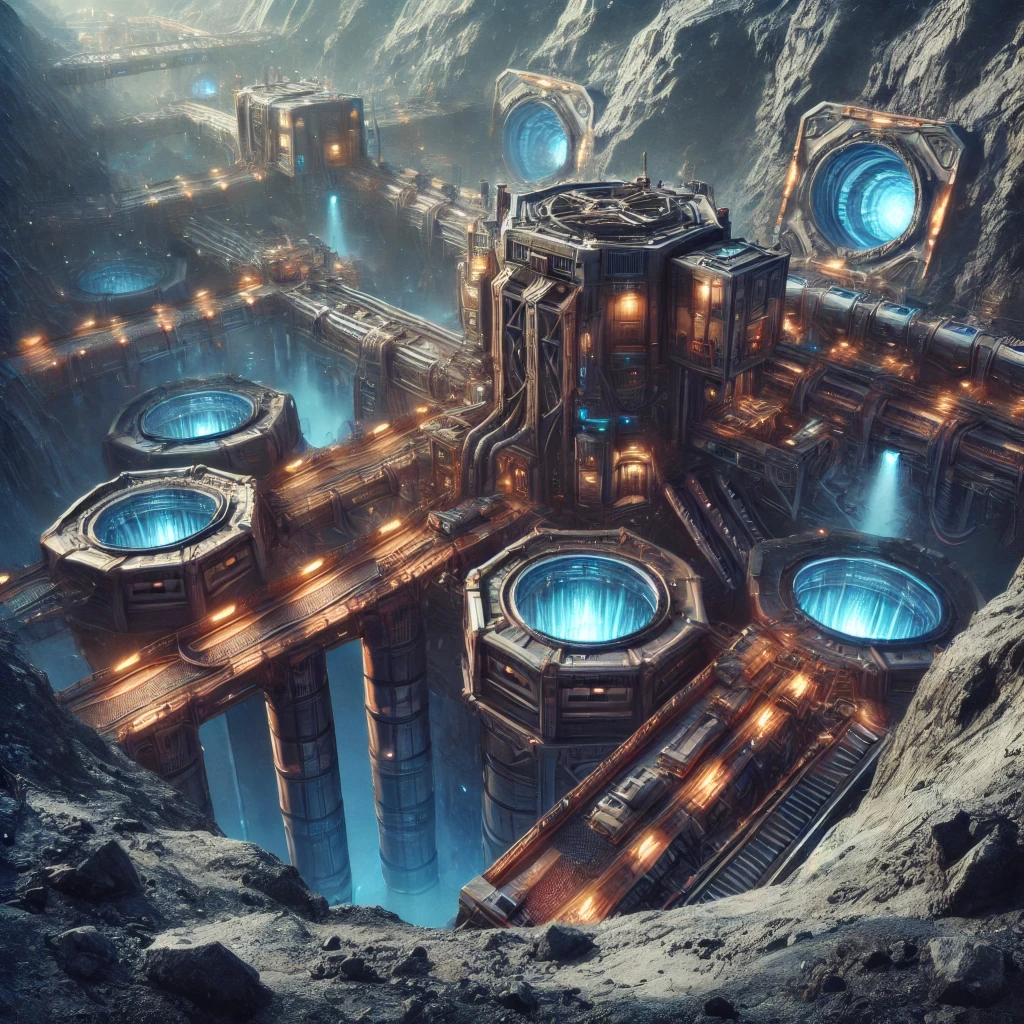 Core MineA deep extraction complex producing large volumes of common minerals and some rare minerals.
 Asteroid MineExtracts rare and strategic materials from orbital bodies.
 StarportConnects trade and migration routes, adds 20 passenger capacity, and increases housing migration capacity by 25% per Starport.
 Orbital MinerDeploys automated extraction rigs that mine common and rare minerals while stationary in orbit, including at uncolonized systems. Can also salvage battle debris while stationed within orbital range.
Resource technologies
Sort systems by their deposits, then place mines and refineries where every building receives the best local multiplier.
A large producer may still be a weak investment when its fuel, minerals, power, or population demands strain the rest of the empire.
Rare minerals, strategic materials, and fuel gate advanced development. Defend the few systems that carry those supply chains.
Advanced details
Each resource keeps fractional production and spending between ticks. Several small gains can therefore add up to a visible whole unit later, even with a single building.
Energy Storage provides 20 reserve-power units per active Power Plant, up to 200 per colony. High-Density Grid Storage raises these limits to 40 per plant and 400 per colony; Antimatter Storage raises them to 80 and 800 when both earlier storage technologies are complete.
Reserves charge from unused generator output after other colony needs are met, at 80% efficiency; Headquarters power is excluded. Stored power becomes usable on a later tick. Staffing, plant condition, and paid storage operation limit how quickly reserves can charge or supply buildings.
resources gained − resources spentavailable workers ÷ required workers, up to 100%